

Form, Function, and the Language of Truth
A Few Old Notes that Still Feel Relevant

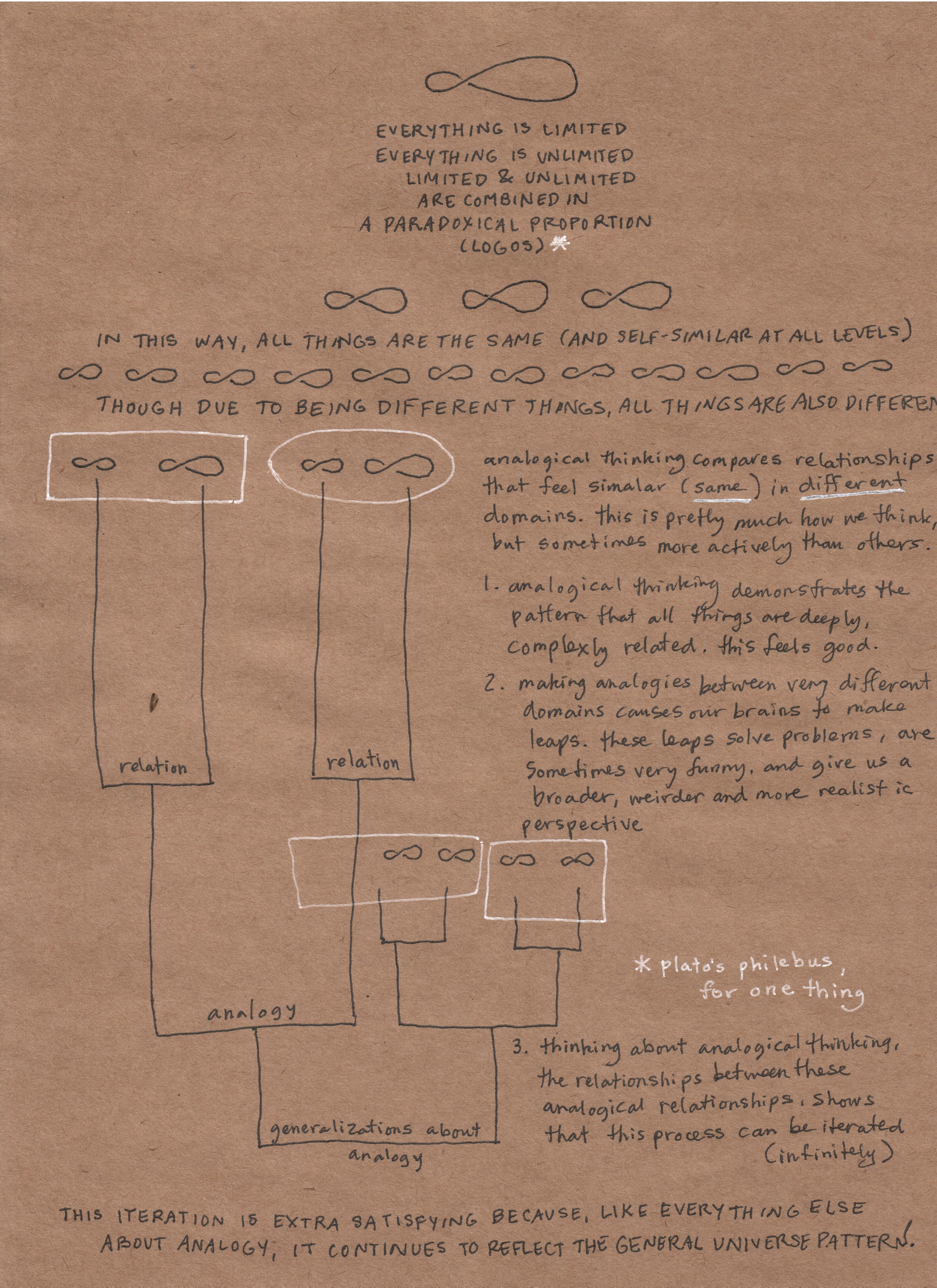
It’s very satisfying to the soul when the medium matches the meaning of a work. This is because we communicate on a variety of levels: intellectual or verbal, physical/somatic, and at least one subtle spiritual level. When the information on these levels doesn’t match, we feel uneasy. For example, when someone speaks politely but their body language is tight and uncomfortable, something about the communication feels wrong. On the other hand, a message that can be communicated in harmony on multiple levels vibrates with obvious truth. In part, this is the marker of truth: that only what is true can be communicated in integrity on all levels. I think a lot about the way that Aristotle said that metaphor (the comparison of things that are alike, but different, such as a message conveyed through both speech and physicality) can’t be taught, and I wonder if it had something to do with this multidimensationality. In a way, none of it can be “taught” because words are only one level of the communication, and receiving such a communication on only one level doesn’t fully demonstrate its fundamental truth.
This type of truth on multiple levels can be expressed in multiple ways, though. It can be apparent in the way human truth resonates in the body, but it also has something to do with certain ways that only true ideas can be actualized in space and form. For example, you could say that there is a polygon in which all the points are equidistant from the center, but good luck expressing that physically. Or, to bring the human and the material together a bit, it could be found in a book where the shape of the message, the images, and even the binding perfectly match the spirit of the work. Books, in fact, are where I first discovered the power of this kind of resonance, of what you could think of as form matching function – especially books around the subject of metaphor, because when books about metaphor skillfully employ metaphorical layering, the truth value can get so self-referential and thick that it’s nearly impossible to miss (though it was quite confusing to figure out *what it is* that I wasn’t missing, at first).
Metaphor, as well as truth, can, however, be learned – especially in an environment where the message is also transmitted on subtle levels. For example, in spiritual traditions where direct transmission is emphasized, you might have the verbal teachings, the behavior of the teachers, and a spiritual or energetic transmission (and if you struggle with that idea the rest should still apply, with just a little less resonance). Existing in this kind of soup, ideally, provides a direct experience of what truth feels like, and sometimes also what it doesn’t.
And, of course, when you define truth as a nervous system experience rather than according to a system of logic (there are lots of decent systems of logic, and, interestingly, you can test them for truth value with your nervous system), there are many kinds of truth that can be communicated in this way. For example, traditions that teach about love can be transmitted in an atmosphere of love. Traditions that teach non-attachment can be transmitted in an atmosphere of non-attachment (and all of the good ones subtly teach this meta-skill of orienting toward truth). A central teaching of the traditions and paths I have been most drawn to, of course, is the one I am writing about here: the teaching that what is true resonates on many levels, and this harmony itself is the mark of truth.
These traditions love a symbol (an agalma, al-mithal) more than anything, because in a symbol – or rather, in the relationship (the logos, if you will) between a symbol and what it symbolizes – lies a fundamental opportunity to experience truth, the harmony of the universe, the relationship between God and the image of God.
Hi Laura — so good to see you in my inbox! I loved this. Blessings to you!